Walk around the ancient church of St Edward’s in Stow-on-the-Wold, Gloucestershire, and you’ll find a doorway worthy of a fairy tale. The north door of the church is flanked by two 400-year-old male yew trees, their trunks and roots moulded around the entrance as if framing a magic portal. It’s rumoured to have inspired Tolkien’s doorway to the mines of Moria in Lord of the Rings.
The last time I visited these trees, as the dregs of October’s afternoon sun slanted across the grass, a dozen people were taking photographs, all falling under the spell of this place. The two male yew trees were already pushing out new flower-buds to shower a springtime day with pollen next year. Nearby, female Irish yew trees stood clipped and bedecked with fleshy red yew-gogs.
Our curiosity in this magical doorway is about how yew trees lend their beauty and organic form to something man-made. Let’s explore that connection between humans and nature, considering this most fundamental of trees.
Holding the darkness
The wizened, richly coloured roots of yew trees twine their way through the darker aspects of Britain’s folklore. At the dark of the year, yew trees seem indestructible, their evergreen needles guarding our sacred spaces, their bright berries taunting the cold. Yew reminds us of life and death, and the tenacity of life in the most difficult of circumstances.
Yew was one of the five sacred trees of Ireland, and it grew entwined on the graves of lovers such as Tristan and Iseult. Ancient kings wore a brooch of yew-wood to remind them of potential death. Yew-sticks were traditionally used for divination, and sometimes to find lost objects. Christianity, at first hostile to this tree, eventually adopted the yew as a symbol of resurrection on Palm Sunday, and a protection against evil spirits.
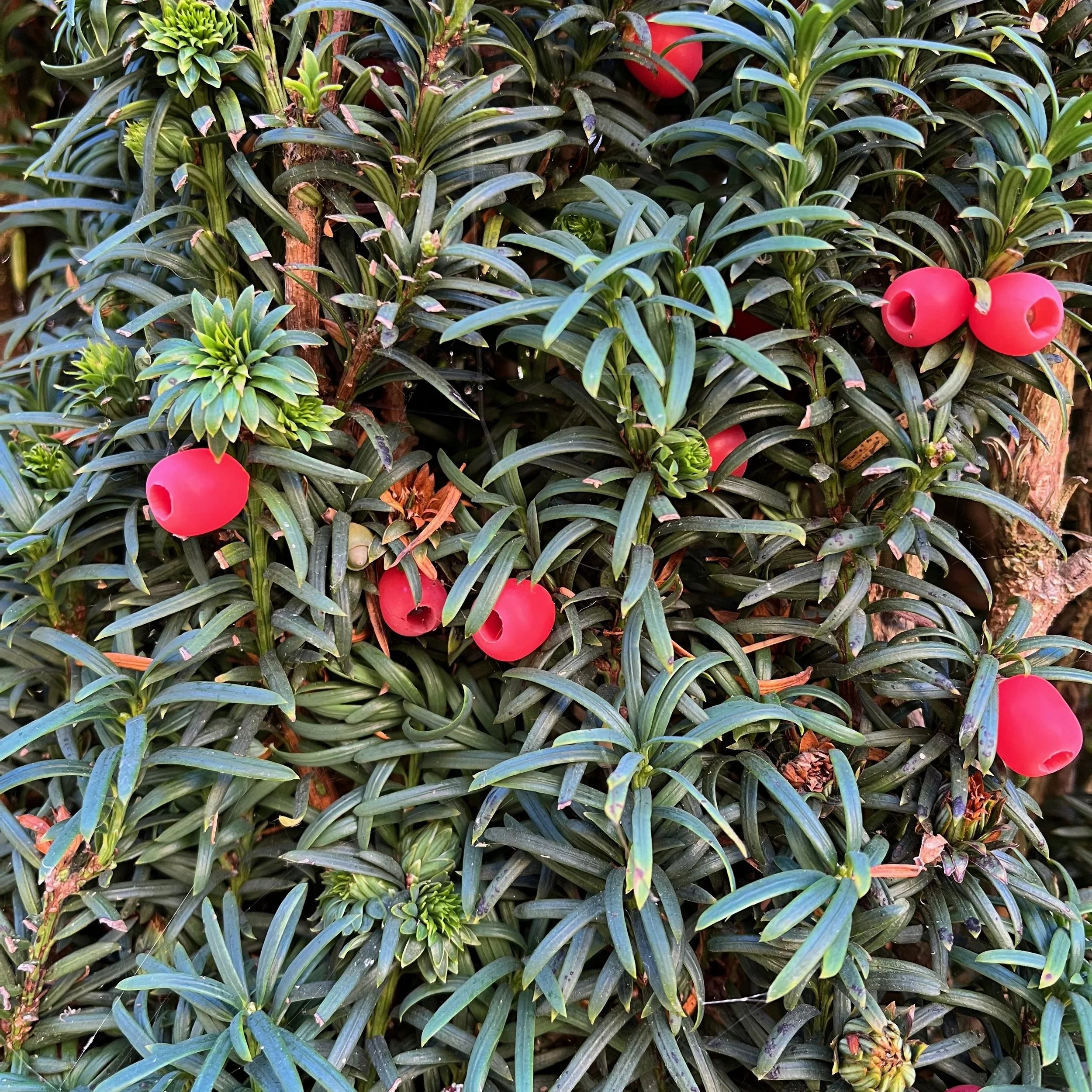
Our death-fascination in the yew tree is reflected in the fact that all parts of the tree are highly toxic, apart from the pink-red flesh around the poisonous yew seed
The dark humour of yew trees has also made its way into our folk tales, such as the story of Ffridd yr Ywen, the Forest of the Yew in Powys. Here, the Tylwyth Teg, the fairy folk, would enchant unwary travellers and make them dance under yew trees for a year as if it were a day, beyond which they could not survive.
Clearly yew is a tree to be treated with caution and respect. But such folklore is not only rooted in our minds and imaginations; it’s about reality. Come outside now and meet the real yew tree.
Earth connections
The yew Taxus baccata is one of several varieties of yew across the globe, and it’s thought to have existed for about 15 million years – now that’s really old! Yew trees have been part of Britain’s native wildwood for about seven thousand years, arriving as trees colonised the land after the last ice age. In the old wildwoods, yew trees would have grown in most parts of Britain, particularly on base-rich and neutral soils, as an occasional tree in in groups in woodland. Individual yews can live for centuries and even millennia if allowed, their branches dipping to the ground and growing anew.
Our death-fascination in the yew tree is reflected in the fact that all parts of the tree are highly toxic, apart from the pink-red flesh around the poisonous yew seed. There are many old stories of people coming to harm by simply sitting under yew trees for too long. Yet these trees are part of a web of life. They are browsed by a wide variety of animals and the berries enjoyed by a wide variety of birds and creatures. More recently, yew has been used in healing: in tiny amounts it is a potent cancer medicine.
The close-grained timber of the yew tree is reputedly harder than iron. Since prehistoric times, hunting bows have been made from yew wood, which makes the most potent and powerful killing machine. As the number of people grew, so did the demand for yew longbows, for hunting and for war.
By medieval times, demand for yew wood in Europe was outstripping supply, leading to a tree-massacre. Yew trees were removed wherever they were found across the whole continent, and the old trees all but vanished. The tree that caused death has itself become endangered, with little effort made to heal the remaining wound. The world moved on; by the end of Tudor times, longbows were being replaced in battle with guns.
Today, Britain contains the highest density of ancient yew trees in Europe, most of them enjoying the protection of churchyards. Over 500 churchyards in England contain yew trees that are older than the church itself. Yew trees may have been planted to protect the dead, or on sites of ancient worship, and the practice has continued to the present day. Many more recently planted yews are of the upright fastigiate (‘Irish’) variety, descended from two trees found in Fermanagh in the 1760s.
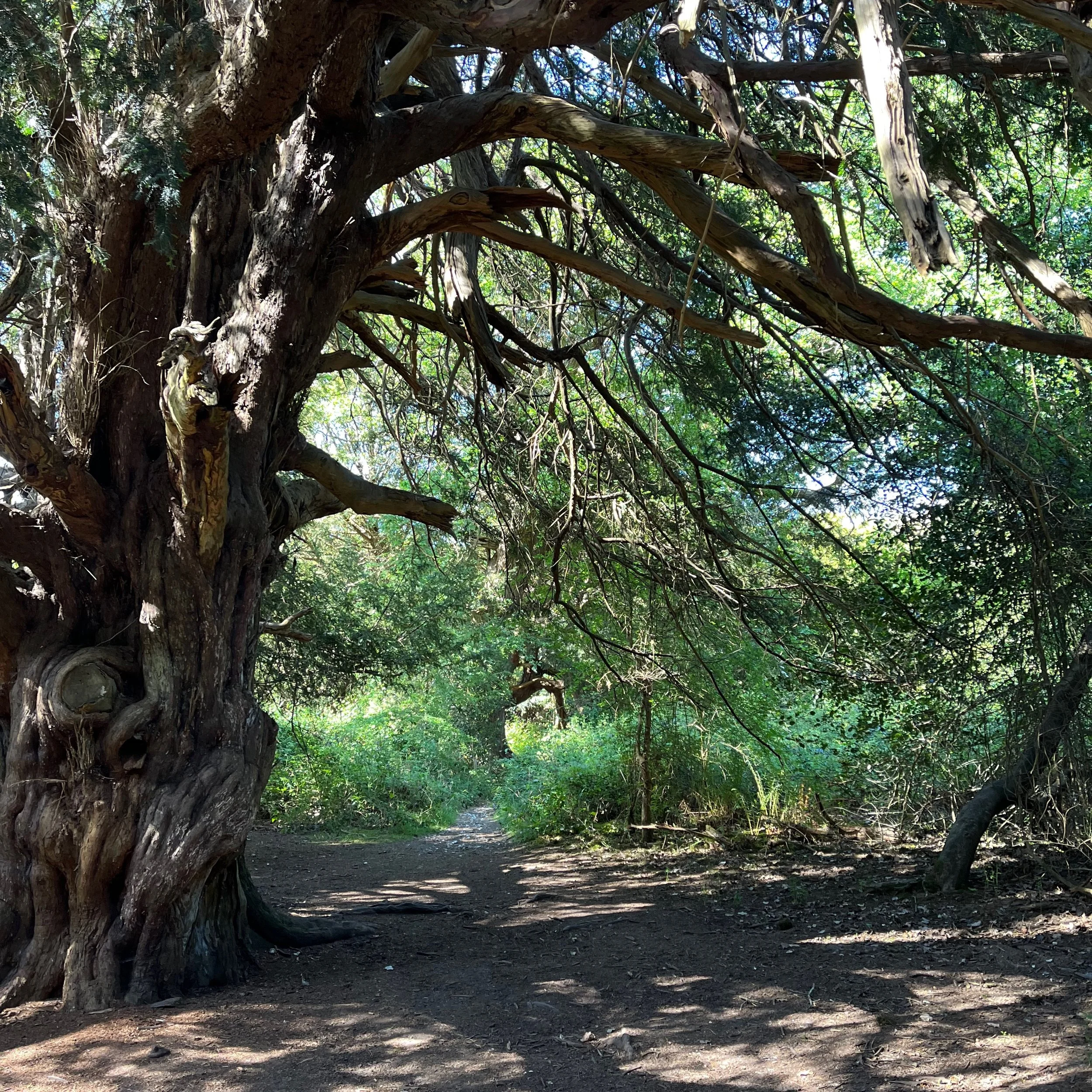
Let folklore dig its fibrous roots into you and fill you with curiosity; allow it to be a magical doorway to the wonders of the natural world around you
A doorway to nature
Whether it’s the tidier ‘Irish’ form or the sprawling ‘English’ variety, there is probably a yew tree near you, living and thriving, whether you’re in city or countryside. I invite you to go and find it and be with it. Run your fingers over its rough bark and watch the light filter through its neat green needles. Wonder at this ancient living thing, this survivor, which provides so much food and shelter for other creatures and stands solid and true and evergreen through the dark of the year.
For yew trees have a number of ecologies, as all species do – of folklore, of story, of history, and of their role in our physical living landscape. Only in finding and exploring those connections will we be awake and alive to the web of life that we are part of.
Let folklore dig its fibrous roots into you and fill you with curiosity; allow it to be a magical doorway to the wonders of the natural world around you. Get out there and discover it. Just don’t eat it.
This article originally appeared in the Under the Ancient Yew zine, published by Brodie Marshall.